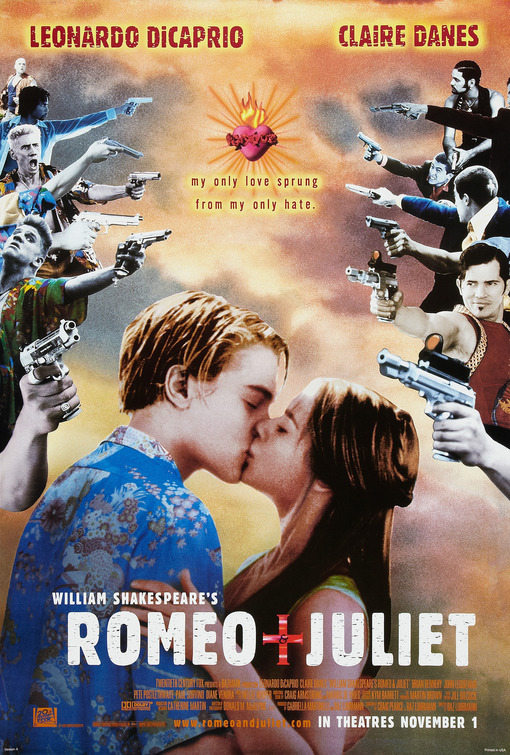
Picture taken from http://www.impawards.com/1996/posters/william_shakespeares_romeo_and_juliet.jpg 15/09/09
For many years people have debated whether it is better to watch a film or read the original text.
This can be quite a hot topic of conversation for many individuals and it is one that we are going to have a look at by utilising an interpretation of Shakespeare's Romeo and Juliet. Shakespeare is long considered to be one of the greatest playwrites of all time and his work has been reproduced time and time again. Australian film maker Baz Lurhmann is one of many individuals who has adapted the tragic love story of Romeo and Juliet. Over the next few lessons we are going to look at what makes this film such a popular adaptation of this centuries old story.
Firstly, you need to consider what you already know about the story of Romeo and Juliet. Even though you may never have read the play, like most individuals, you may already be familiar with what the story is about. On your blog, write down as many things that you already know about the play, or that you think the play may be about.
Also, you need to write what your thoughts are prior to watching the film, i.e Do you think you will enjoy it and why? Or, do you think it will be completely awful and you wish you weren't being forced to watch it? Whatever your opinion may be at this point, you need to explain the reasoning behind your answer. We will look back at these interpretations after we have finished watching the film.